THE ROLE OF COLOR IN FORMING EMOTIONAL PERCEPTION IN PAINTING
DOI:
https://doi.org/10.31652/3041-1017-2025(5-1)-12Keywords:
color, emotional perception, method, paintingAbstract
The article examines the role of color in a person’s everyday life, determines the influence of color on his psychophysiological state. Color and its physical and psychological nature are described. Attention is paid to the meaning of color in the culture and symbolism of different peoples of the world. Color, as a composition of color, is one of the components that directly appeals to the eye and sets the viewer up for an emotional response - this is especially connected with the human perception of various types of art (painting, architecture, sculpture, photography, cinema, decorative and applied arts, design, and others). The authors focuses on the role of color in the formation of emotional perception in painting, emphasizes important elements of composition, thanks to which it is possible to use contrasting colors and highlight details or certain objects in the picture in order to interest the viewer. Attention is paid to the psychology of color. An algorithm for the formation of emotional perception in painting using color is presented. It is concluded that color harmony in painting is an aesthetically pleasing combination of colors that creates a sense of unity and balance in a work of art and is achieved using basic methods, such as monochrome harmony, which creates a sense of calm, depth and integrity of the image; analog harmony, which creates a sense of softness, harmony and smoothness; complementary harmony, which creates a sense of contrast, energy and dynamics; triad harmony, which creates a sense of balance, harmony and completeness; tetrode harmony, which creates a sense of complexity, richness and diversity. It is emphasized that each method has its own characteristics and influence on the viewer’s perception of paintings. The interpretation of different colors is presented. Color is one of the most important means of artistic expression. It is proven that color has enormous emotional potential and can affect the viewer at different levels and stages of perception. It is noted that understanding the psychology of color and skillful use of it in painting allows artists to create deep, emotionally rich works that are able to evoke a wide range of feelings and experiences in viewers. Attention is paid to computer technologies, in particular, computer graphics and color image processing. Practical advice on the use of color in painting is provided.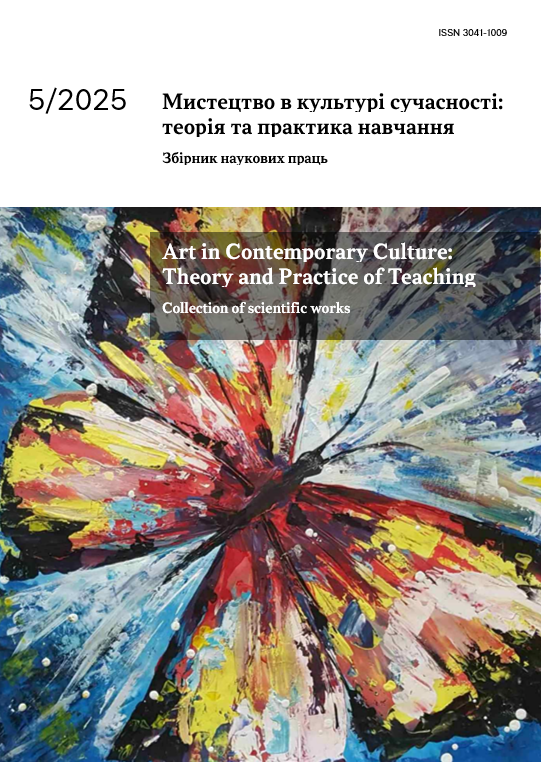
Downloads
Published
2025-01-01
Issue
Section
Articles
License
Copyright (c) 2025 Copyright Holder Not Found

This work is licensed under a Creative Commons Attribution 4.0 International License.
You are free to:
- Share — copy and redistribute the material in any medium or format for any purpose, even commercially.
- Adapt — remix, transform, and build upon the material for any purpose, even commercially.
The licensor cannot revoke these freedoms as long as you follow the license terms.
Under the following terms:
- Attribution — You must give appropriate credit, provide a link to the license, and indicate if changes were made. You may do so in any reasonable manner, but not in any way that suggests the licensor endorses you or your use.
- No additional restrictions — You may not apply legal terms or technological measures that legally restrict others from doing anything the license permits.
Notices:
- You do not have to comply with the license for elements of the material in the public domain or where your use is permitted by an applicable exception or limitation.
- No warranties are given. The license may not give you all of the permissions necessary for your intended use. For example, other rights such as publicity, privacy, or moral rights may limit how you use the material.
How to Cite
Holinska, T., & Solovei, V. (2025). THE ROLE OF COLOR IN FORMING EMOTIONAL PERCEPTION IN PAINTING. Art in Contemporary Culture: Theory and Practice of Teaching, 5, 100-107. https://doi.org/10.31652/3041-1017-2025(5-1)-12